
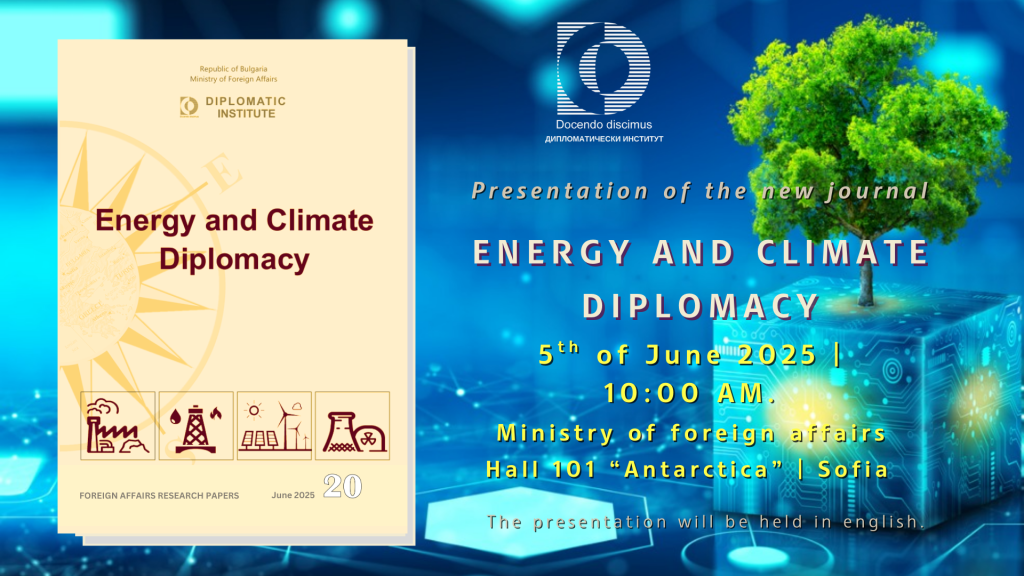
Just in time for the Green Transition Forum 5.0, Ellen Wasylina is pleased to announce her contribution to the Energy and Climate Journal of the Diplomatic Institute of the Ministry of Foreign Affairs of Bulgaria .
The Editor in Chief, Slavtcho NEYKOV has brought together a fine group of contributors around many strategic issues of our day .
Invited by Mr Neykov to submit a paper, Ellen was pleased to contribute her paper entitled « Green Diplomacy in the Black Sea Region – steps towards peace, growth and prosperity »
Here is the introduction :
- INTRODUCTION
The European Union’s move towards legislation on due diligence in supply chains is an important step in creating sustainable international trade. It will take the active participation of producers, national regulators, international market regulators, and a broad range of civic society to fill in the blanks. But therein lies the problem: not all partners are on equal footing.
The accelerating triple planetary crisis of climate change, biodiversity loss and pollution aggravate existing security concerns from ongoing armed conflicts worldwide, compounded by the harm to the climate and the environment, resulting in great human suffering. This might be noted on e.g. in the context of Russia’s invasion in Ukraine since February 2022; or in the war between Israel and Gaza , after the horrific October 7, 2023 attacks and kidnapping undertaken by Hamas etc.,.
At the European level, a key question appears – how decarbonisation and major initiatives like the Green Deal, the Competitiveness Compass and the Rearm Europe Plan, supplemented by the Mario Draghi Report can all function and are the basic guidelines in them not contradictory. In fact, this question was asked at the press conference that took place on March 9, 2025 to mark 100 days of President Ursula von der Leyen’s second mandate.
In parallel, with all the recent events, the dress down of President Zelenskyy in the Oval Office on February 28 by President Trump and Vice-President Vance, clearly have made the European Union rethink its posture and security, not only on rearming Europe, as the United States paused its defense and intelligence to Ukraine, but on energy and other national security parameters such as nuclear, rare earth and renewable energies and their supply chains.
Without any doubt, along this general frame, a Green Diplomacy agenda is needed also for the Black Sea region – particularly when looking beyond the Russia-Ukrainian war, and to push the economies of the countries in the region to the next level, while also avoiding a new Cold War.
The EU has set its Green diplomacy as a political priority and so it should be for the Black Sea countries. It is defined as “accelerating a global just and inclusive green transition”, by the EU Consilium on March 18, 2024, which includes a multilateral approach with partner countries.
On this premise, the current analysis would explicitly deal with policy issues of countries in the Black Sea region. Thus, inter alia, as one of the largest riparian countries of the Black Sea, particular attention would be paid on how Türkiye can use Green Diplomacy as a strategic component of its soft power approach, to build bridges with its neighbors, fostering goodwill, and enhance its influence through environmental sustainability efforts. Another look would be on different Green diplomacy typologies by zooming in on several Black Sea countries, such as Bulgaria , Romania and Ukraine – as they all attempt to address critical global challenges and at the same time strengthen their standing and appeal on the world stage etc.
Certainly, there are risks and challenges, which have European and global dimensions. In this context, e.g., to put a finer point on this new Cold War, it is worth noting the major risks as identified and published by the World Economic Forum’s annual Risk report for 2024, presented just before the Davos gathering in January 2025. Accordingly, these are the top five of the ten major climate risks:
- In two years, these are the top five risks, which have been identified :
- disinformation and misinformation;
- Extreme weather events ;
- Social polarisation;
- Cybersecurity insecurity;
- Interstate armed conflict.
- In the next ten years, the picture is rather bleak , and almost all the risks are climate or nature related :
- extreme weather events
- Critical changes to Earth’s systems
- Bio diversity loss and system collapse
- Natural resource shortage
Therefore, reaching a consensus on such risks, is thus crucial to reaching common agreement on decisions, which would improve their individual and collective resilience, while via green diplomacy best practices could stave, prevent, foresee the upcoming destructive national and regional disasters.
To continue reading her contribution and the contributions of other authors of this annual publication , herewith the link : https://www.emi-bg.com/en/21589/

Leave a comment