
We all know the feeling. A piece of music moves us to tears before we can explain why. A dancer’s gesture catches in our chest before our mind has formed a single thought about it. Something has been communicated — powerfully, unmistakably — yet no words were spoken, no message was sent.
This podcast explores how that happens.
Music and dance are the two great arts of time and the body. Both unfold in motion — one through sound, the other through physical movement — and both reach us in ways that bypass ordinary language. Yet despite centuries of music theory and dance scholarship, the question of how they communicate remains surprisingly unresolved.
The answer lies in the body itself. When we hear music or watch a dancer, our bodies do not remain passive. They resonate, lean, anticipate, and respond — often before conscious thought catches up. This bodily resonance is not a side effect of the experience. It is the experience. Music and dance communicate primarily through the body, through a kind of physical attunement between performer and audience that makes meaning feel immediate, shared, and real.
First, consider each art in turn — how music creates meaning without words, and how dance creates meaning without sound. Second, bring them together to ask what happens when music and movement combine. Something genuinely new emerges: a communicative richness that neither art nor humans can achieve alone, one recognized in virtually every human culture throughout history.
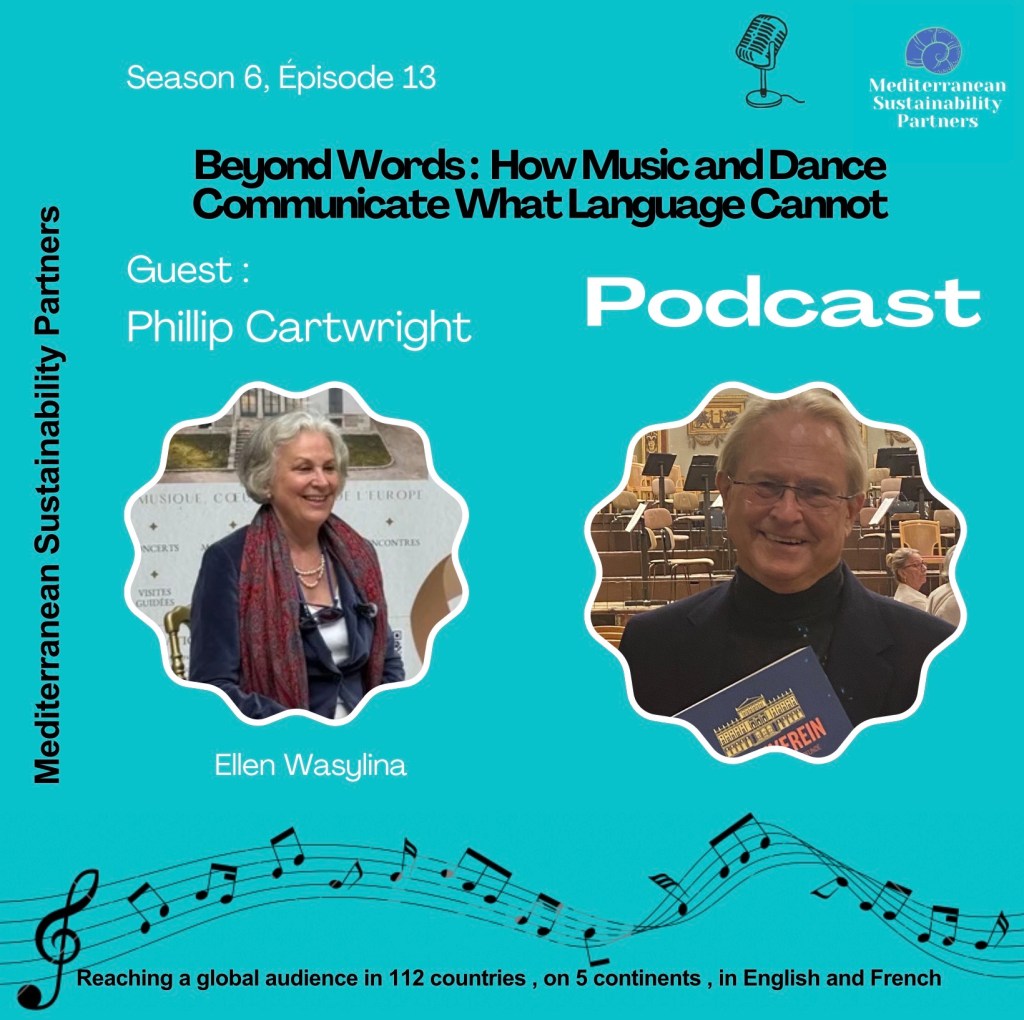
Here is the link to the podcast :
Here is a short bio of Phillip Cartwright :
Phillip (Phil) Cartwright is an American citizen raised in the Chicago area and has lived in France for 30 years. A Ph.D. in economics from the University of Illinois, Urbana-Champaign, with support from the MIT Energy Research Lab, he has forty years of academic and business experience. Today, he is a Full Professor, Visiting Researcher, Royal College of Music, London. Phil’s teaching and research interests include quantitative methods, performance science, music composition, and choreomusicology. He is the Founder of HorizonVU Sound and Movement. He studies music at the Berklee College of Music, classical dance at the Stanlowa Institute, and cello. He is a member of the American Economic Association, American Psychological Association, American Musicological Society, the Dance Studies Association, the Society for Dance Research, and the International Dance Council CID at UNESCO, Paris.
